What is coaching – and what isn't it?
Coaching is a structured, one-to-one relationship in which a coach helps a client to think more clearly, act more effectively and achieve meaningful outcomes. The coach does not provide answers. They ask better questions, create space for genuine reflection, and hold the client accountable to what matters most to them.
What makes coaching distinctive is its forward focus. A coach assumes you are resourceful and capable, and works with you to unlock that capability rather than diagnosing what is wrong. This separates it from several things coaching is often confused with.
Coaching vs. Therapy
Therapy addresses the past – trauma, mental health conditions, deep psychological wounds. Coaching starts from where you are now and works toward where you want to be. If significant past experiences are interfering with your present functioning, therapy is the right first step. If you are functioning well and want to move forward more effectively, coaching is the right fit.
Coaching vs. Mentoring
A mentor has been where you are and shares the benefit of their own experience. They offer advice, connections and perspective from a specific journey. A coach draws out your own thinking rather than superimposing theirs. Both have value; the question is whether you need someone's experience or someone's full attention to your particular situation.
Coaching vs. Consulting
A consultant diagnoses a problem and prescribes a solution. A coach helps you develop your own answers through better thinking. If you need an expert to analyse something and tell you what to do, consulting is right. If you need to think and act more effectively in your own context, coaching is right – and often produces more lasting change.
Coaching vs. Training
Training transfers knowledge and skills in a structured format. Coaching applies thinking and insight to your specific situation and circumstances. Many leaders benefit from both: training builds the toolkit, coaching ensures it is used well in the moments that matter.
How coaching varies – five dimensions
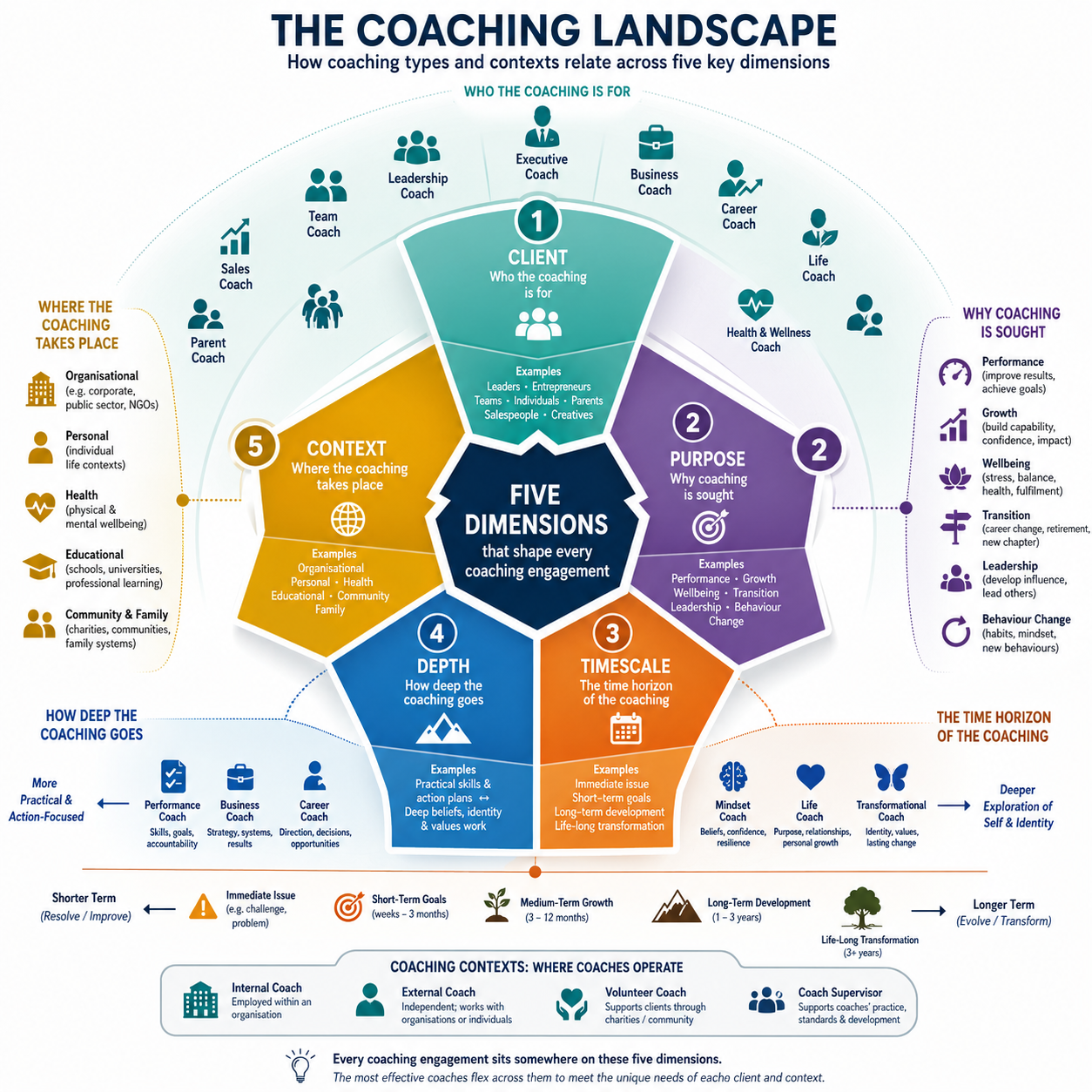
Not all coaching is alike. It varies across five dimensions, each of which influences what kind of coach is right for a particular client at a particular moment. Understanding these helps you identify not just whether coaching is right for you, but what kind of coaching.
What kind of coach do you need?
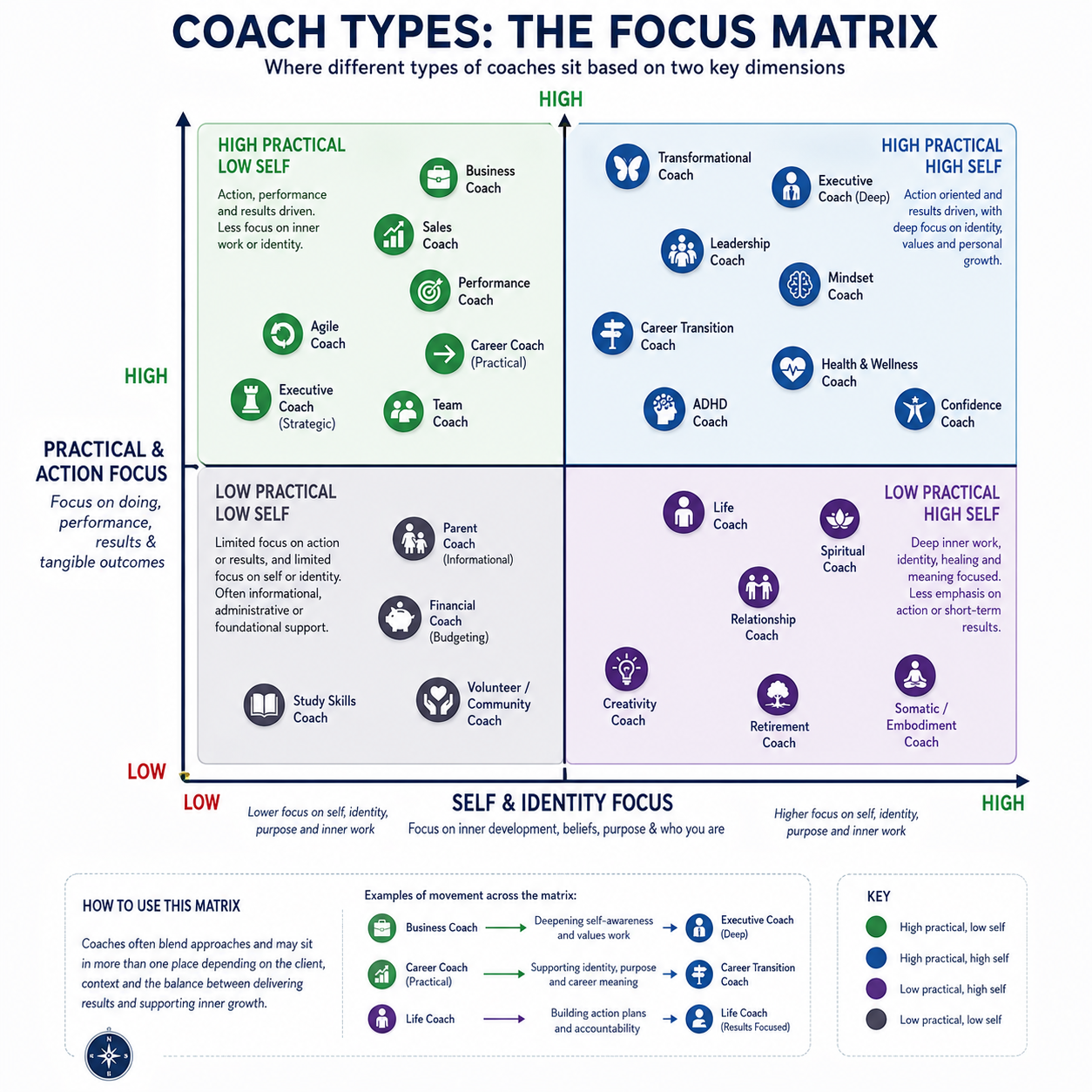
There are more than twenty recognised types of coach, varying significantly in their focus. One useful way to map them is on two axes: how action-oriented and results-driven the work is, and how much it focuses on identity, values and inner life. Different positions on this map serve different clients at different moments.
Action-oriented coaching that goes beneath the surface
Matthew works in the top-right quadrant: his coaching is action-oriented and results-driven, and it goes beneath the surface to work on the beliefs, patterns and identity-level dynamics that are often the real source of the challenge a leader brings to the first session.
For senior leaders, what is holding them back is rarely a lack of information or technical skill. More often it is something in how they see themselves, their team or their situation – a belief that is no longer serving them, a pattern they have not yet named, or a question about what they actually want from the next chapter of their career. That is why effective executive coaching at this level has to work at both levels simultaneously: the practical and the personal. Sessions are structured enough to always move the needle, and deep enough to get at the root cause.
If you are a leader dealing with a significant challenge – a new and demanding role, a team that is not performing, a plateau in your own performance, a major career decision, or a deeper question about where you are heading – Matthew is likely to be a good fit. The best way to find out is a conversation.
Questions to ask yourself before engaging a coach
These questions help determine not just whether coaching is appropriate, but what kind of coaching relationship is likely to be effective. Click Prompts to help you reflect under any question to go deeper.
- What has changed recently that makes this feel timely?
- Is there a particular challenge, transition, or frustration driving this?
- What happens if I do nothing for the next 6–12 months?
- What would be different in my day-to-day work or life?
- What would I be doing more of, less of, or differently?
- How would I measure progress or success?
- Is this about capability, clarity, confidence, or identity?
- Where do I feel most stuck or uncertain?
- What level do I sense this issue really sits at?
- Am I willing to hear things I might not agree with at first?
- How do I typically respond to challenge or feedback?
- What might get in the way of me fully engaging?
- What approaches have I already tried?
- What helped, even partially?
- Where did things stall or fall away?
- Do I want advice and suggestions, or questions and reflection?
- When have I learned or grown most effectively in the past?
- What balance of support and challenge works best for me?
- What level of commitment feels realistic and sustainable?
- What might I need to prioritise or deprioritise?
- How serious am I about making this change?
- What qualities or behaviours help me feel psychologically safe?
- What would build credibility and rapport for me?
- What would undermine trust?
- What do I feel I need most right now?
- Where have I struggled to follow through on my own?
- What kind of support would make the biggest difference?
- What early signs or shifts would I notice?
- How will I track progress over time?
- At what point would I reassess or adjust the approach?



Questions to ask prospective coaches during a discovery call
The aim is to assess both competence and fit. Click What to look for in the answer under any question to reveal guidance on interpreting the response.
Look for relevance and depth rather than prestige alone.
- A clear description of the types of clients and situations they work with
- Pattern recognition – common challenges, transition points, leadership issues
- Examples that feel grounded and specific, even if anonymised
- Overly generic claims ('I work with all kinds of people on everything')
- An overemphasis on status without substance
A credible coach should hold recognised qualifications.
- Recognised coaching qualifications – not just short courses or unrelated training
- Accreditation or active progress towards accreditation with the ICF or EMCC
- The ability to explain what they learned and how it informs their practice
- Reliance on life experience alone
- Dismissal of qualifications as unnecessary
- Explicit adherence to a recognised ethical framework – confidentiality, boundaries, client autonomy
- The ability to explain how ethics show up in real situations, not just 'I follow a code'
- Awareness of limits, including when not to coach
- Vagueness or overconfidence without reference to boundaries
This is often overlooked but is an important mark of a serious practitioner.
- Confirm regular supervision with a qualified supervisor
- Explain that supervision supports reflection, challenge, and safeguarding client interests
- Show openness to being held accountable in their own practice
- Dismiss supervision as unnecessary
- Show little understanding of its purpose
Look for clarity and congruence between what they describe and how they show up in the conversation itself.
- Describe how they actually work – degree of challenge, structure, use of tools
- Acknowledge that style flexes depending on the client
- Be transparent about what they will and won't do (e.g. advice-giving versus facilitation)
- The style sounds overly rigid, or
- So vague that it is meaningless
- Set out a clear but flexible framework – session frequency, duration, review points
- Include some form of goal-setting and periodic review
- Balance structure with responsiveness to the client's evolving needs
- Overly loose ('we\'ll just see how it goes'), or
- Overly prescriptive with no room for flexibility
- Clear recognition that coaching is distinct from therapy, consulting, or legal/financial advice
- Willingness to refer on when issues fall outside their competence
- Comfort in naming their own limits
- A coach who implies they can handle anything
- Collaborative goal-setting at the outset of the engagement
- Regular check-ins against those goals
- A mix of subjective (insight, confidence) and objective (behavioural change, outcomes) measures
- Purely intangible measures with no accountability, or
- Overly rigid metrics that ignore the human element
- Anonymised but specific examples demonstrating their thinking and approach
- Evidence of process – how they worked, not just what the outcomes were
- Reflection on what was learned from the engagement
- Superficial or overly polished
- Light on insight into how the coach actually operates
- Clearly state what they commit to – confidentiality, presence, challenge, professionalism
- Be equally clear about what they expect from the client – honesty, commitment, follow-through
- Position the relationship as a partnership rather than a service transaction
- Expectations are entirely one-sided
- They are not articulated at all
Overall indicators of a good fit
Across all answers, look for:
Ready to start a conversation?
Book a free, no-obligation 30-minute discovery call with Matthew to explore whether coaching is right for you, and whether we are the right fit for each other. Select a time directly below.
Prefer to send a message first? Use the enquiry form on the coaching page.